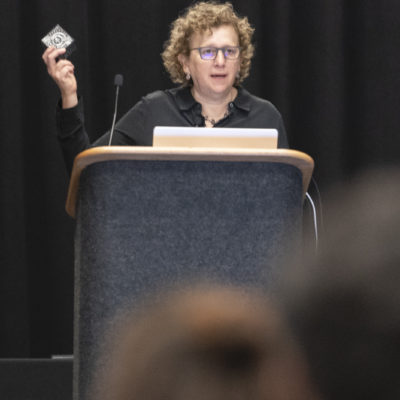
Sean Carroll studies the regulatory mechanisms that govern the formation and
structure of body parts, which are crucial to understanding both an
animal’s development, and its evolution. He has shown that changes in
genetic regulation can give rise to the diversity of body plans and body
parts, and the origin of new patterns. The next challenge more…
Surely the conditions that lead to insurgency and war depend upon such things
as ideology, anger, the desire for revenge and other factors unique to each
location, to each insurgent group, to each mortal conflict. Neil Johnson and
his colleagues, experts in the modeling and understanding of complex systems,
weren’t buying that assumption. They reviewed 11 more…
The “holy grail” of autism research is to be able to diagnose it
many months before its symptoms are clear, giving doctors time to change its
course before it has seeped into and resculpted the brain of an affected
child. Researchers disagree over whether this will ever be possible, but Ami
Klin has little doubt. “There more…
In 2001, Jo Handelsman spoke at New Horizons in Tempe, Arizona, where she
told us about her pioneering work in extracting DNA of previously unknown
organisms from soil—an area of study known as metagenomics. These were
organisms that could not be cultured in the laboratory, and so the DNA
revealed bits of countless organisms unkown to more…
A special symposium celebrating the 50th Anniversary of the Council for the
Advancement of Science Writing. Program arranged by Ben Patrusky and the CASW
Board. As part of its half-century celebration, CASW has brought back three
pioneering researchers whose talks proved especially prescient when they
spoke at previous New Horizons in Science meetings. Each has been more…
Some patients with depression are helped by therapy, or drugs, or, more
often, a combination of the two. But for others, nothing medicine has been
able to offer could soften the blackness and bleakness of the illness. Helen
Mayberg is working hard to change that, using a technique called deep-brain
stimulation, in which electrodes are inserted more…
Supported by a large body of data, the current cosmological model describes
the evolution of the Universe from a very early burst of accelerated
expansion, known as inflation, a tiny fraction of a second after the
beginning, through the assembly of galaxies and large-scale structure shaped
by dark matter, to the present epoch and the rule more…
Antibodies make excellent drugs for such things as rheumatoid arthritis and
cancer, but they can’t be taken as a pill, and they can cause
life-threatening allergic or immune responses, only making matters worse.
David Spiegel has a work-around. He is developing antibody recruiters that
can induce a patient’s own antibodies to attack illnesses such as more…
If you’re a gene and you don’t make a messenger RNA that makes a
protein, you’re useless. Or so researchers thought until they
discovered genes that were once as invisible to us as the dark side of the
moon. According to this central dogma in biology, there are about 26,000
genes in our cells that make more…
The Deepwater Horizon oil spill has been referred to as the worst
environmental disaster in our nation’s history. As Lohrenz points out,
scientific observations played a critical role in the response to the crisis
and in understanding the impacts on the marine life and ecosystems in the
northern Gulf of Mexico. But the magnitude of the more…
In November, 2009, hackers released emails from climate researchers at the
University of East Anglia in England, prompting wide-ranging attacks on
climate research and climate researchers—Michael Mann among them. The
author of the famous “hockey-stick” graph of temperatures over
the past millennium, Mann was not amused; indeed, for a time his career as
one of more…
Why do people often sharply disagree about things that scientists mostly
agree on? As Dan Kahan has written, “The same groups who disagree on
'cultural issues' — abortion, same-sex marriage and school prayer
— also disagree on whether climate change is real and on whether
underground disposal of nuclear waste is safe.” How could views on more…
How do we make decisions and exercise judgment? We might expect that these
are uniquely human activities, among the things that distinguish us from our
non-human primate relatives. But Santos is pursuing a different
notion—namely, that some aspects of the irrational decision-making that
human adults are famous for might be shared with children and monkeys. Santos more…
For 50 years, researchers have pursued the idea that cancer cells divide
quickly. All the drugs developed so far are aimed at those cells. Such drugs
now cure 80 percent of cases of ovarian cancer. But much of that cancer
recurs within 2 to 5 years, and when it comes back, it kills many of the more…
When we report on clinical trials, we need to ask ourselves the following
questions, Krumholz says: Where is the kernel of truth that really matters?
When does a study convey more spin than substance? Why is it sometimes so
hard to determine exactly what a study says? Krumholz brings the perspective
of someone who does such more…
At the 1988 briefing in Boulder, “Future Climate/Future Life”
served as the rubric for tandem presentations by Ralph Cicerone and the late
Stephen Schneider, both at the time senior atmospheric scientists at the
National Center for Atmospheric Research. Among the issues under scrutiny
then: How fast – and how far – would temperatures rise in more…
In the course of his exceptional career, Lee Hood has lived through, and
helped in significant ways to catalyze, four major paradigm shifts in biology
(i.e., the joining of engineering to biology, the human genome project,
cross-disciplinary biology and, of late, systems biology). Together, he
explains, they have brought us to the threshold of the next more…
State, a psychiatrist who went back to school to study genomics, has become
one of a group of elite researchers using the newest and fastest genomics
analysis—so-called high-throughput technology—to pursue the genes
behind Tourette syndrome, autism, obsessive-compulsive disorder and other
neuropsychiatric ailments in children, which have clear genetic components
but which have proven elusive and more…
About 700 new chemicals are introduced each year, on top of 80,000 already in
use. Since 1976, the EPA has restricted the use of five existing chemicals,
according to Zimmerman. “If you live and breathe in the United
States,” she says, “you are exposed to chemicals with little or
no knowledge of their impacts on health more…
The 2010 New Horizons in Science briefings, hosted by Yale University, will be held in New Haven, Connecticut, Nov. 6-9. New Horizons is held in conjunction with the annual meeting and workshops of the National Association of Science Writers as part of ScienceWriters 2010.