“A fundamentally new technology”: David Awschalom on quantum information science
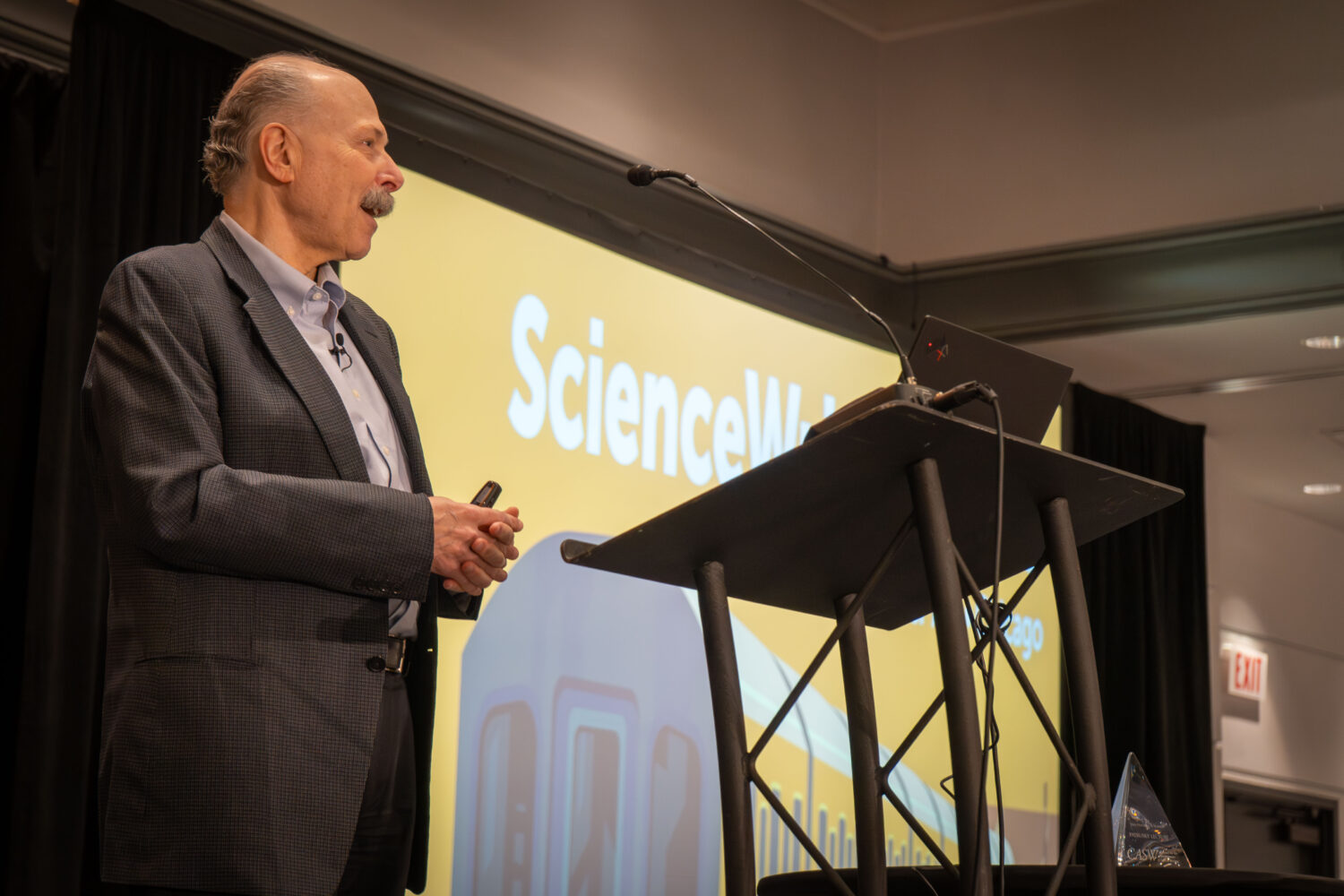
David Awschalom, director of the Chicago Quantum Exchange, delivers the Patrusky Lecture during the ScienceWriters2025 conference in Chicago. (Photo: Daniella Garcia‑Loos Almeida)
Technology has reshaped society in ways once presumed unimaginable — the first ARPANET message transmitted in 1969, for example, laid the foundation for the internet. Today, quantum technology is enabling a similar leap, said quantum information scientist David Awschalom during the Council for the Advancement of Science Writing’s 13th annual Patrusky Lecture on Nov. 8.
Quantum science is ushering in the “birth of a fundamentally new technology” through “the creation, engineering and control of quantum states of matter,” said Awschalom, director of the Chicago Quantum Institute at the University of Chicago Pritzker School for Molecular Engineering, at the ScienceWriters2025 conference in Chicago.
More than 30 years ago, while he was a scientist at the IBM Watson Research Center and the University of California in Santa Barbara, Awshwalom observed that quantum states could be generated and controlled in common materials more easily than previously thought. The quantum world is governed by a different rulebook than classical physics and computing, he explained.
With a quantum bit, or “qubit,” information isn’t limited to zeros or ones but can exist as a superposition in which the “actual state depends on how and when you observe it,” Awschalom said. The quantum phenomenon of entanglement enables qubits to communicate without any physical connection. Using these principles, researchers have developed processors for quantum computing that surpass the ability of today’s supercomputers to store vast amounts of information.
Awschalom’s lab recently demonstrated quantum sensing using genetically encoded proteins within living cells. His team turned enhanced yellow fluorescent proteins into optically addressable functional qubits capable of sensing nanoscale magnetic fields.
Since these quantum sensors are proteins, they can be directly expressed in cells, holding the potential for intercellular sensing of things like chemicals and temperature. This intersection of quantum technology and biology could one day “revolutionize medicine” from pharmaceutical design to disease detection, he said.
Quantum technology is already being used in secure communications, tools for fraud prevention, autonomous navigation systems, materials science and energy, Awschalom said. He pointed to Chicago’s 124-mile quantum communication network, a testbed for quantum secure technology, which will eventually connect quantum computers across the nation and the world.
Collaborations across multiple disciplines — including physics, chemistry, biology, electrical engineering and computer science — are leading to new applications. For example, the aviation industry is using quantum optimization algorithms to streamline airplane design and improve flight-gate assignment efficiency.
As for the next evolution of quantum technologies, Awschalom said, “the only thing we know for sure is we have to be prepared.” He called for scientists, engineers, lawyers, ethicists and science writers to work together to increase awareness, address the wide-ranging implications of this new technology and prepare all of us for the imminent quantum era.