Jack Szostak on the origin of life
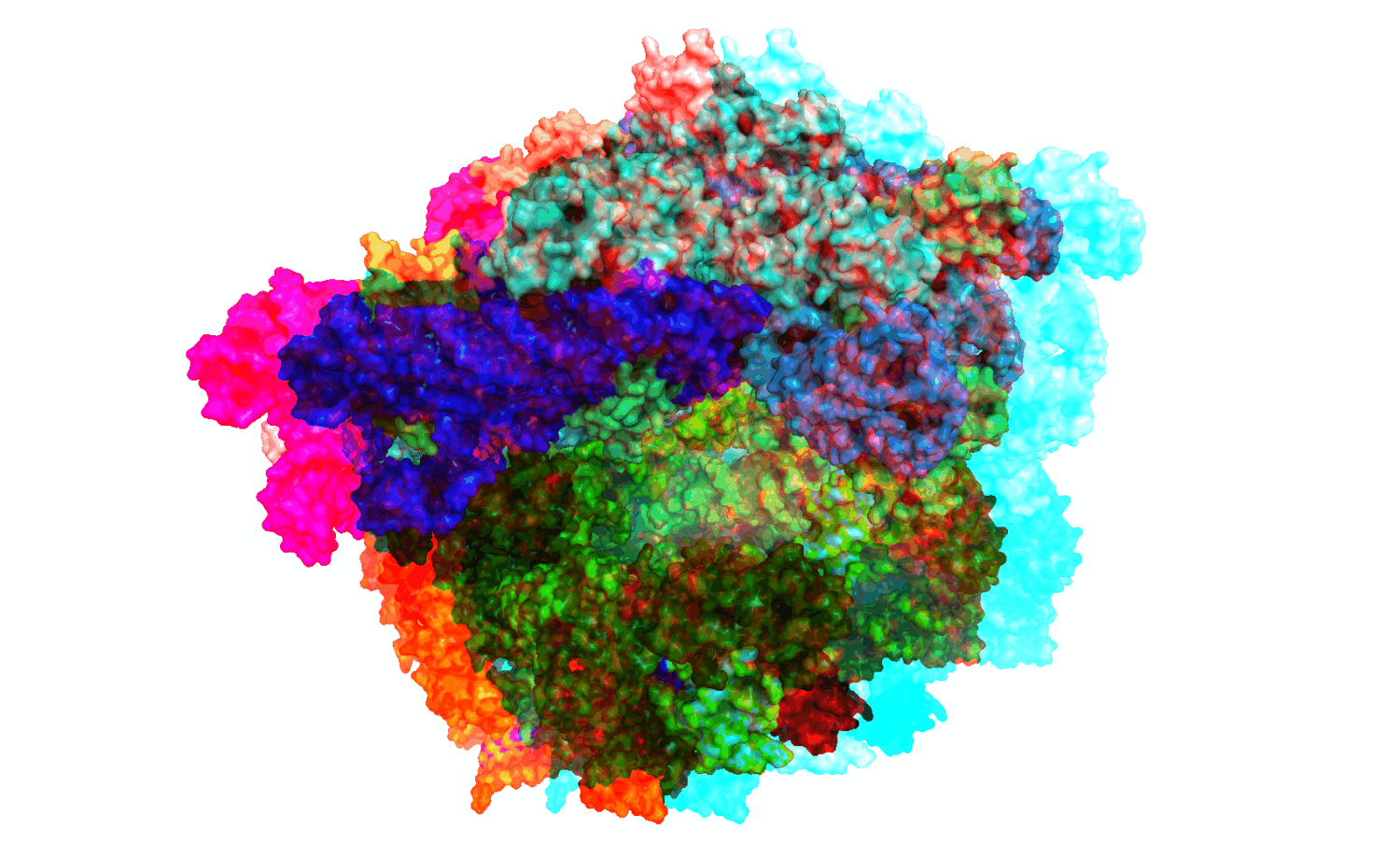
The ribosome, shown here in a stereoscopic 3D image created from structural data, is a biological machine that makes every protein in every cell on Earth. Credit: Jason Vertrees, Wikimedia Commons (CC BY-SA)
When Nobel laureate Jack Szostak asked the crowd at the ScienceWriters2025 conference in Chicago whether life is widespread in the universe, hands went up across the room. When he asked who thought life was so rare that Earth might be the only inhabited planet, nearly as many hands were raised.
“I love this,” the University of Chicago chemical biologist said, speaking during the Council for the Advancement of Science Writing’s New Horizons in Science briefing on Nov. 9, “because it illustrates how people like to have a position on something [for which] we just don’t know the answer.”
That uncertainty drives Szostak’s work. For 25 years, he has been trying to create life from scratch in his laboratory—not to play God, but to understand the chemical pathways that led from a lifeless early Earth to the first living cells. His goal is to build a “protocell,” a primitive membrane-bound structure containing genetic material that can grow, divide and replicate.
His work builds on ribonucleic acid (RNA), which is unique in that it can both carry genetic information and act as an enzyme to speed up chemical reactions. Scientists exploring the RNA world hypothesis believe there may have been a time when primitive cells relied solely on RNA for their survival.
The best evidence comes from the ribosome, a biological machine found within every cell on the planet. Ribosomes are primarily made of RNA, and Szostak argued that their existence suggests RNA came before DNA. Eventually, ribosomes evolved the ability to make proteins, and the formation of life followed.
But how did RNA first arise on early Earth? Before life existed, everything had to happen through chemistry and physics alone. How did the RNA world emerge from chemistry, and how was the RNA world transformed to give rise to life in the present?
To answer this question, Szostak described how organic compounds could have accumulated on early Earth. Such accumulations do not happen today because, as Szostak put it, “the whole planet is contaminated with life” that quickly consumes organic compounds. Before life existed, though, organic compounds could build up and crystallize into storage reservoirs.
One of the best examples of this phenomenon in today’s world is, ironically enough, cyanide. Though deadly to modern organisms, cyanide is a high-energy molecule. It forms readily in the atmosphere in the presence of ultraviolet light, lightning and meteor impacts. When cyanide-laden rain runs into lakes in areas with hydrothermal circulation, such as volcanic regions or impact craters, heated water circulates through rocks and brings ions to the surface. Iron reacts instantly with cyanide to make ferrocyanide, a nontoxic compound found in iodized salt. Thus, cyanide can be stored in a stable form and accumulate over time.
But once these compounds accumulate and concentrate, they must still somehow form into primitive cells. Szostak explores this “how” question with his lab’s protocells, which he describes as looking “like a soap bubble, except in water.” The cells are composed of basic fatty acids, typically derived from oleic acid found in olive oil, which self-assemble into spherical membrane boundaries that trap RNA within them. Now that the assembly of these primitive cells is complete, the next challenge is figuring out how to make them grow, divide and replicate.
Szostak’s team has used bridged nucleotides—modified bits of RNA—to improve the copying accuracy of RNA sequences. But life requires replication, in which the genetic material reproduces itself, to evolve. When RNA is copied, the new strand pairs with the original template strand. In order to replicate, these paired strands must be separated. But they recombine faster than copying can occur. “It was so hard we didn’t even want to think about it,” Szostak said.
During the COVID-19 pandemic, unable to work in the lab, Szostak’s team hit upon a possible solution: a virtual circular genome model. In this model, short RNA segments are arranged in a circular structure. As they move around the circle, they continuously separate and recombine in new configurations, allowing replication to proceed. His lab is currently focused on testing whether this circular genome can actually function in protocells.
In an interview following the briefing, Szostak reflected on why understanding the origins of life matters. “It’s just a very human thing to want to understand how life got started and give rise to us,” he said. “Almost everybody is curious about that.”
Szostak’s lab is inching closer to a protocell system that can grow, divide and replicate its genetic material. If this project succeeds, it would mean witnessing the processes that preceded modern biology: primitive cells emerging in the lab from chemistry alone. Perhaps the universe is full of life after all.