Uncovering the tangled story behind AI’s water use
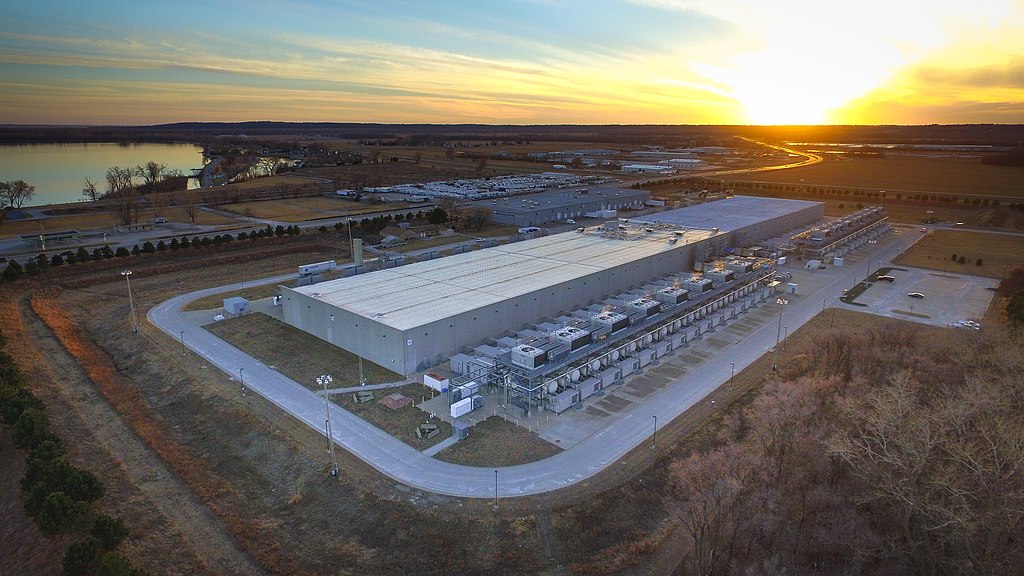
Aerial view of the Google Data Center in Council Bluffs, Iowa. (Credit: Chad Davis, Wikimedia Commons, CC-BY-2.0)
One news source states artificial intelligence, or AI, may use up much of the water around Illinois and deplete drinking water sources. At the same time, a social media post argues AI consumes much less water than leaking pipes and “isn’t going to destroy the environment.”
According to Shaolei Ren, associate professor of electrical and computer engineering at the University of California Riverside, “the actual, real story about AI water [use] is a lot more nuanced.” Ren spoke during the Council for the Advancement of Science Writing’s New Horizons in Science briefing at the ScienceWriters2025 conference in Chicago on Nov. 9.
AI uses algorithms to learn from large amounts of data, identify patterns and make predictions. AI data centers house powerful, specialized computers and information technology infrastructure designed to provide the fast networking and large-scale storage needed to handle AI’s massive computing demands.
Researchers studying AI’s environmental impact tend to focus on energy use. By 2028, U.S. data centers will make up an estimated 6.7% to 12% of the nation’s demand for electricity, according to a 2024 report from Lawrence Berkeley National Laboratory (LBNL). On a per-query basis, even small AI queries in ChatGPT are estimated to consume at least 0.34 watt-hours of energy, equivalent to the amount a lightbulb uses in a couple of minutes. The larger the query, the greater the energy drain.
But energy consumption is only part of the picture. Energy creates heat, and data centers use water to cool their systems. LBNL predicts that by 2028, massive or “hyperscale” data centers engineered for large-scale workloads will consume some 60 billion to 124 billion liters of water. That’s “double or even quadruple the 2023 number,” Ren said, which LBNL estimated at about 35 billion gallons.
Whether this amount of water is considered large or not depends on framing, Ren said. Some might consider it inconsequential, as it is equivalent to fewer than 10 days of the United States’ total public water leakage. On the other hand, it is more than Rhode Island’s annual public water supply.
It’s hard to know exactly how much water data centers are using. “A lot of data centers don’t have even a water meter to track their water usage, so it’s really hard to get an exact number on water consumption,” Ren said. LBNL’s estimates are based on computer simulations, partly because of the lack of direct water data.
Water use, Ren said, is “much more than a single number”; where data centers use water may be even more important. According to Bloomberg News, since 2022, more than two-thirds of the new data centers in the United States were built in locations where demand for water exceeds the available supply. This pattern suggests developers did not prioritize water supplies when choosing where to build data centers, Ren said.
AI companies’ estimates of water usage vary dramatically. Google says the median Gemini text prompt consumes 0.26 milliliters (about five drops) of water on average, whereas Mistral AI estimates that each query on its AI model consumes 45 milliliters. Models vary in type and size, and tech companies disclose information in different time frames and to different extents. Some analysts directly compare numbers, but Ren said doing so can lead to “misleading or misinformed” conclusions. “All of the numbers can be correct within their own context,” he said, but without context, direct comparisons are “not really meaningful.”
“What is the true water footprint of AI, even on a quick per-query basis? The answer is we don’t know,” Ren said.
Ren and his team have developed a way to better estimate AI’s water footprint using a novel calculation method that replaces one measure of water efficiency with another. With this method, they discovered that training GPT-3, a highly advanced large language model with 175 billion parameters, in Microsoft’s data centers can directly evaporate 700,000 liters of clean freshwater.
To allow for truly sustainable AI, we need to acknowledge the connection between water and energy and address both problems together, said Ren. “AI data centers, of course, have a lot of benefits,” he said. But they also have “some physical footprints, including energy, water usage, and public health impacts. These are the real costs, and we need to face them.”