Will cuts in science funding and immigration crackdowns spur a U.S. brain drain?
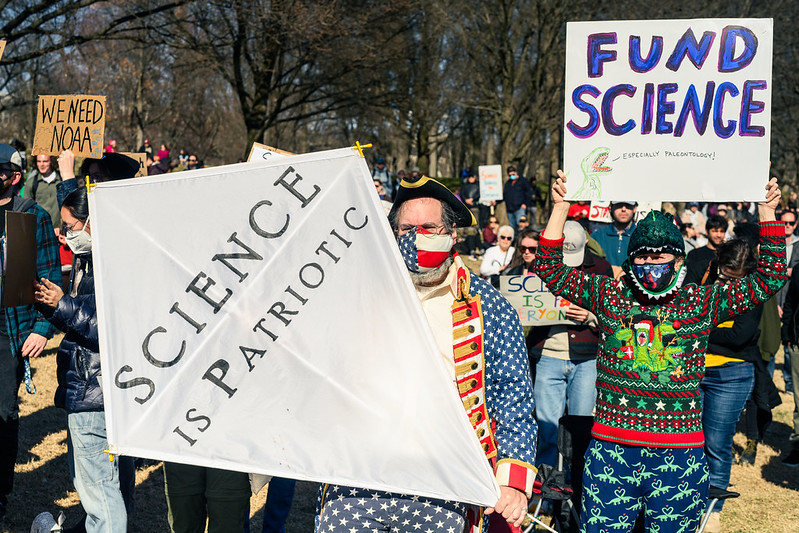
A Stand Up for Science protest in March 2025. (Photo: Geoff Livingston/flikr.com/Creative Commons License)
Amid significant cuts to U.S. research funding, attacks on higher education, and increased scrutiny of immigrants, many supporters of science are concerned that the United States will see a brain drain—a mass exodus of both immigrant and American-born scientists in search of better opportunities elsewhere, said Ina Ganguli, an expert on the role of migration in scientific innovation, during the Council for the Advancement of Science Writing’s New Horizons in Science briefing at the ScienceWriters2025 conference in Chicago on Nov. 8.
Immigrant scientists play a significant role in driving science and innovation by both filling jobs and creating them, said Ganguli, professor of economics at the University of Massachusetts-Amherst. While she said it was too early to tell if the United States will lose a significant number of scientists and new discoveries as a result of the Trump Administration’s policies, Ganguli said she believes historical precedents could suggest what the future holds.
Ganguli proposed three main questions about the relationships between immigration and science productivity: Are scientists who emigrate from countries with a low gross domestic product (GDP) per capita more productive in the United States than if they had stayed in their home countries? Do immigrant scientists increase the productivity of the U.S.-born scientists they work with? And what are the lasting impacts on universities when a country experiences a brain drain?
To address the first question, Ganguli cited data from a 2024 study tracing the career paths of winners of the International Mathematics Olympiad (IMO), which offers researchers a representative global pool of high-achieving students. They found that IMO medalists from more developed countries were more likely to seek doctoral degrees than those from countries with a lower GDP per capita, and that students overwhelmingly sought to obtain their doctorates in the United States regardless of their country of origin. Ganguli said the resources and networks of mathematicians in the United States allowed immigrants to be more productive than in their home countries.
Ganguli’s own work has explored whether immigrant scientists increase the productivity of the U.S.-born scientists working with them. In a 2015 study, Ganguli found that U.S.-born scientists in cities with high Russian immigrant populations cited significantly more Soviet-era papers than those in cities with lower Russian immigrant populations, illustrating the diffusion of knowledge that the Russian immigrants brought with them. “Students and scholar mobility seem to be this driver of knowledge creation,” she said.
Ganguli also discussed the expulsion and persecution of Jewish scientists from Germany during the Nazi era. While U.S. research benefited greatly from those who chose to immigrate to America, German universities lost a generation of scientists. This knowledge gap can be a major problem for universities; it is much easier to recover from a loss of university infrastructure than from the loss of people, Ganguli said. In fact, it took Germany at least half a century to recover its pre-World War II research output.
Still, it’s unclear whether these examples suggest the Trump Administration’s policies will push the United States toward a brain drain. “Unfortunately, I’m not going to be able to tell you an answer,” Ganguli said.
But there are some indicators that a brain drain may be starting, she said. In her field of economics, the two 2019 Nobel Prize winners, a married couple who are both foreign-born, left the United States for Switzerland, citing Trump policies that make U.S. academia a hostile environment for science.
“This is where there has to be a concerted effort, well-designed policies, to try to reverse [the out-migration of scientists],” Ganguli said. “But if the policies are contributing to the brain drain, then it’s probably [impossible] to reverse course.”