Q&A with Juan Gilbert: How artificial intelligence could be used for social good
Juan Gilbert, professor at the University of Florida, presents his research to writers gathered at ScienceWriters2026 in Corvallis, Oregon. (Photo by Lauren Hines-Acosta)
Concerns about artificial intelligence are growing amid rapid development of the technology. But Juan Gilbert, distinguished professor at the University of Florida, believes AI and other computing technologies can be used for social good.
Gilbert leads UF’s Computing for Social Good Lab, which develops technologies to solve real-world problems, from protecting elections from hackers to de-escalating traffic stops.
Gilbert presented many of his projects during the 14th Patrusky Lecture, a keynote address that opened the Council for the Advancement of Science Writing’s New Horizons in Science briefing at the ScienceWriters2026 conference in Corvallis, Oregon, on Sept. 26.
The address took place in the midst of a public debate about generative AI sparked by researcher Jacob Coxon’s Sept. 8 resignation from his job with the AI company Anthropic. Coxon alleges that AI industry leaders are acting irresponsibly.
As an example of responsible use of AI, Gilbert described Applications Quest, which his lab designed as an unbiased and efficient system to filter applications for a job or college admission.

ChatGPT and other popular generative AI models are trained with large, historical datasets to generate new content. Applications Quest is built differently, through unsupervised learning, meaning that it applies an algorithm to a given dataset without a human having trained it beforehand with historical data.
Hiring and admissions staff using Applications Quest can set a minimum qualified threshold to level the playing field for a collection of applicants. The software analyzes the applications, groups them into clusters, and sends a recommendation list to staff.
In a study testing the technology in Gilbert’s lab, Applications Quest made scholarship decisions two weeks faster than a University of Florida committee. Gilbert also said the system’s recommendation pool of screened applicants was “holistically diverse,” meaning that there was variation in many attributes. In this way, a machine selection process might create a diverse pool without explicit consideration of traits such as race or gender.
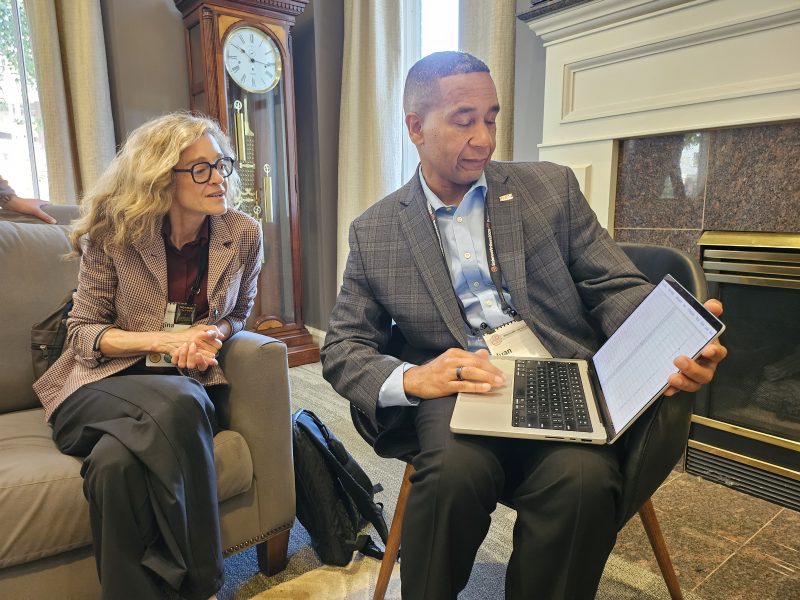
New Horizons Newsroom reporters and other conference attendees asked Gilbert about his views on the use of artificial intelligence in a group interview after the lecture. The following questions and answers have been edited for brevity and clarity.
Q: How can AI be used for social good?
A: I would love to see a way to integrate AI in the communities that are underserved and, in particular, low-income. So, I’m not telling you how because I want someone to come along and innovate that. I think there’s a role it can play in entrepreneurship. Take a young kid that’s coming up from an underserved background, low-income — they have ideas, aspirations. Can AI help take those and just put them on steroids some kind of way?
Q: How do you not lose the human side that would accept students with potential who may not be perfectly qualified in the Application Quest process?
A: We do not sacrifice that. It’s a capacity issue. So, you have a specific number of slots. The provost, or whoever has privilege, can admit who they want and take up X number of slots. We have Y remaining slots. Then we go through the process where you set the bar and you have people compete. But admissions officers — it doesn’t prohibit them from reading the application. So, we don’t say the human side is not part of this. We can incorporate that. I actually encourage that.
Q: What are your thoughts on Jacob Coxon saying AI developers are acting irresponsibly?
A: When the National Academies had a commission after the [2016 presidential] election accusations of Russian involvement, we were able to bring in key people under testimony and create briefs. We need the same thing with those whistleblowers. We need to understand more. There are a lot of questions that need to be asked.

Q: How legitimate are Coxon’s fears about AI?
A: It doesn’t matter how real you think they are. I would ask that differently; I would ask how credible. They were on the inside; if anybody would know, they are the people who would know. That’s why I’m concerned, because they have infinite credibility. They gave up a lot to do this; they could be wrong, but we need to know if they’re right. And the only way to know that is to put them under oath and have a conversation with them.