Will Oregon cities be prepared for the Big One?
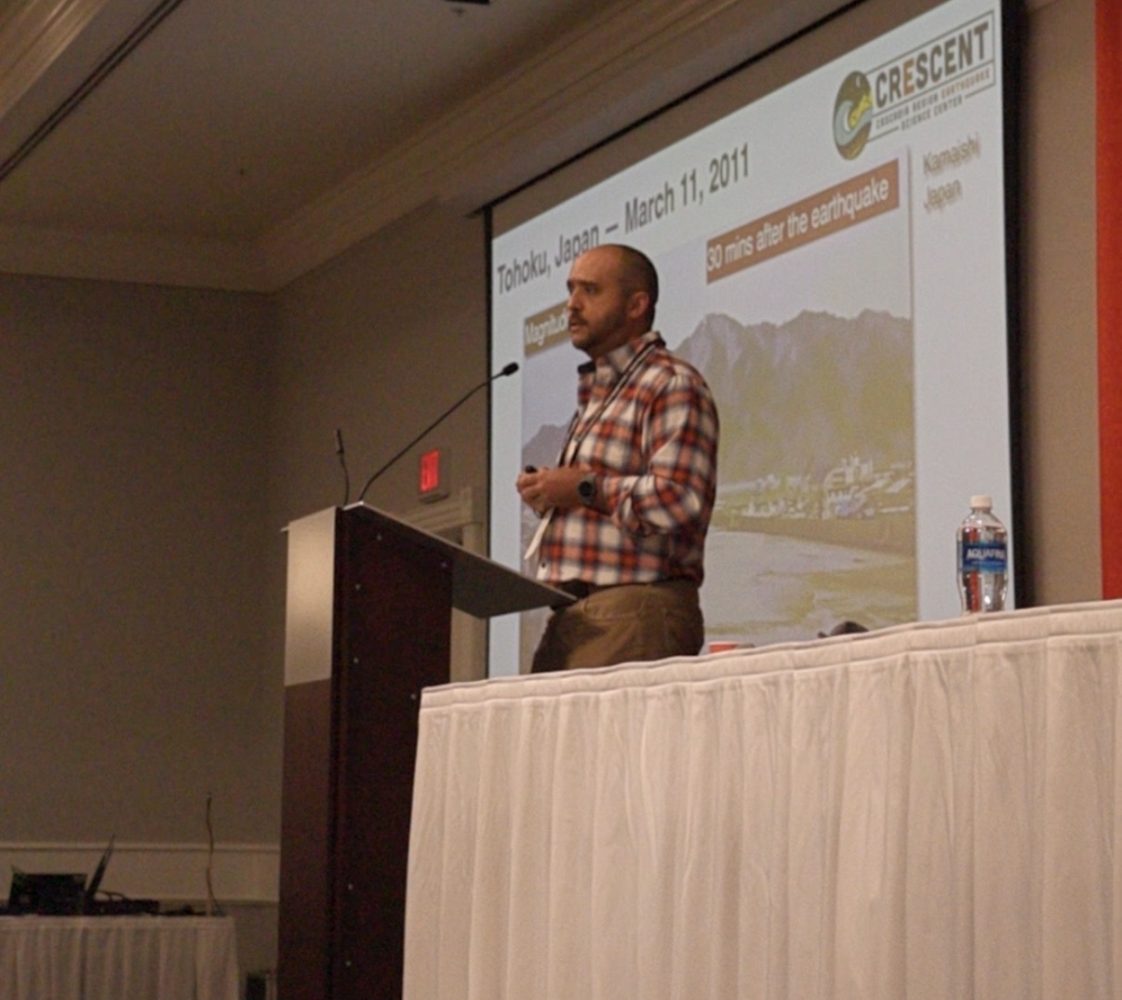
Diego Melgar, director of the Cascadia Region Earthquake Science Center, spoke of the potential earthquake impacting the Pacific Northwest at the ScienceWriters2026 conference in Corvallis, Oregon. (Photo by Emily Tenorio Molina)
Pay attention to the Big One.
That was the message that Diego Melgar delivered to science writers attending a conference in Corvallis, Oregon, Sept. 27.
The audience gasped as they heard projections of more than 30,000 casualties and more than $81 billion in economic losses from a catastrophic Cascadia Fault earthquake and tsunami scenario affecting Oregon and Washington.
Melgar, director of the Cascadia Region Earthquake Science Center (CRESCENT) at the University of Oregon, studies earthquakes and their potential impacts in the Pacific Northwest. He spoke as part of the Council for the Advancement of Science Writing’s New Horizons in Science briefing at the ScienceWriters2026 conference, hosted by Oregon State University.
The Cascadia Subduction Zone is a roughly 700-mile-long fault zone that runs offshore along tectonic plate boundaries from Northern California to British Columbia, where the Juan de Fuca oceanic plate is being pushed beneath the North American Plate.
The last Cascadia earthquake, estimated at magnitude 8.7 to 9.2, occurred on January 26, 1700.
Although the earthquake happened more than 300 years ago, scientists have been able to reconstruct what happened by studying geological evidence.
That includes looking at tree rings, tsunami deposits, coastal land-level changes, and “ghost forests.” By studying the stands of trees that died after being exposed to saltwater, scientists can identify when coastal land subsided during past earthquakes.
Melgar explained that another Cascadia earthquake might trigger a tsunami that could quickly reach the Oregon coast. He compared the potential disaster to the 2011 earthquake and tsunami in Japan.
“Up to the mid-1980s and into the ’90s, people mostly thought there were no earthquakes here,” Melgar said, adding that many communities across the Pacific Northwest were built without future earthquakes in mind. For example, an earthquake in Corvallis could liquefy soft sediments, much like jelly, increasing the potential for damage to the town’s buildings and infrastructure.
Melgar advocates for retrofitting vulnerable buildings and keeping building codes current. He argues that adapting to earthquake risk, bit by bit, can help the state prepare over time, rather than waiting until after a disaster.
Melgar stressed the importance of scientists developing better ways to address environmental and natural-hazard challenges by working with Indigenous communities to draw on Indigenous Traditional Ecological Knowledge (ITEK) — knowledge, practices, and beliefs developed through generations of interaction with the environment.
Indigenous oral histories have contributed to scientists’ understanding of past Cascadia earthquakes and tsunamis. But in the past, Melgar said, “because we didn’t really feel earthquakes very frequently, Indigenous knowledge was discredited.”
Melgar also argued that more attention and government funding should be directed toward the social impacts of scientific discoveries. Educating policymakers, emergency managers, communities, and other stakeholders through scientific research can make a difference.
“Bit by bit, one day at a time, and over the centuries, that’ll add up to a truly resilient society.”