The sky belongs to everyone now, thanks to the Vera C. Rubin Observatory
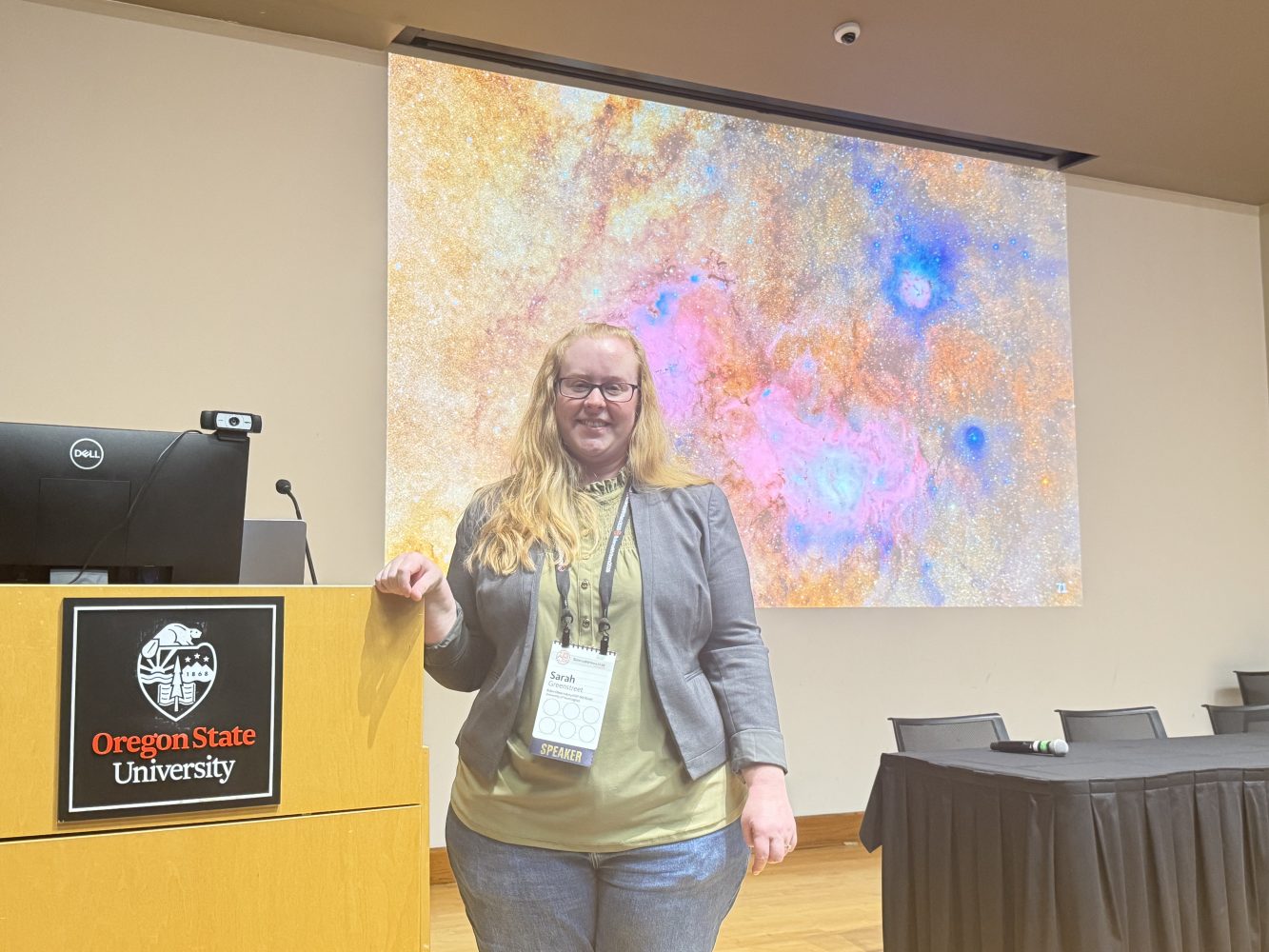
Sarah Greenstreet, an astronomer at NSF’s NOIRLab and the University of Washington, describes the Rubin Observatory during the New Horizons in Science briefing at the ScienceWriters2026 conference in Corvallis, Oregon. (Photo by Wardah Noor.)
Humans have been admiring the night sky since the earliest days of prehistory, searching for things they could not yet name. Now an observatory on a Chilean mountaintop is opening the sky to everyone, in more detail than ever before.
The new observatory — named after Vera C. Rubin, a pioneer in astrophysics whose observations provided the first evidence of dark matter — in June launched a decade-long survey of the night sky. Funded by the U.S. National Science Foundation and Department of Energy, the Rubin Observatory will photograph the entire Southern Hemisphere sky every few nights, building a first-of-its-kind time-lapse view of the universe.
Sarah Greenstreet, an astronomer at NSF’s NOIRLab and the University of Washington, updated science writers on the project during the Council for the Advancement of Science Writing’s New Horizons in Science briefing at the ScienceWriters2026 conference in Corvallis, Oregon., Sept. 27.
The Rubin Observatory’s instruments — mirror design, camera, optics, telescope speed, and computing infrastructure — are all the first of their kind, Greenstreet said.
The Simonyi survey telescope moves 350 tons of steel and optics fast enough to rotate 180 degrees in 17 seconds, allowing it to take a new image roughly every 40 seconds. The camera that will provide images for the LSST (Legacy Survey of Space and Time) is the largest digital camera ever built: With 3,200 megapixels, it is the size of a small car and has enough resolution to spot a golf ball 15 miles away.
Rubin’s predecessors — the Hubble, James Webb, and Nancy Grace Roman space telescopes — take deep targeted images of small patches in the sky. Rubin has a much broader view, capturing 45 times the area of the full moon in every single image.
Its comprehensive survey of the universe will fulfill four main objectives: mapping the Milky Way, taking a census of the solar system, and tracking the changing sky. It will also probe dark matter and dark energy, the invisible material that holds galaxies together, and the mysterious force driving the universe to expand ever faster.

Rubin is expected to find some five million new objects in our solar system — more than three times the number of objects that have been discovered in the last 225 years.
The continuous scanning of the sky every three nights produces an unprecedented flood of data — 10 terabytes each night — for a total of 500 petabytes over the decade, making it the largest astronomical data set in the history of optical astronomy.
Most of the data becomes public as soon as it is processed. The observatory sends up to millions of alerts each night, flagging anything in the sky that moves or changes. Even the slightest change in brightness is recorded, so that scientists from around the world can participate in the discoveries that the observatory will make.
For Greenstreet this openness is the point. “One of our sayings from the beginning is that we want to democratize the universe,” she said. “No one owns space.” In a moment of strained public trust in science, she said, “It is our job as scientists to be sharing what we learn within our fields, with the rest of the world.”
Space “ignites this curious fire within each of us,” said Greenstreet, who is excited about “unknown unknowns” that the observatory might find, like the dark matter Rubin herself stumbled onto. “I truly think that this observatory really, truly is going to revolutionize our understanding of the universe,” she said.
“I am extremely honored to work for an observatory that is named after one of these trailblazing women in astronomy,” Greenstreet said of Vera Rubin, who spent her career advocating for women in science. Greenstreet hopes her own work “can continue to keep doors open for anyone who also comes after me.”