After a long, dry summer in Oregon, the first fall rains come as a relief to most. But to salmon, they can be a death sentence.
In the early 2000s, scientists began noticing large die-offs of coho salmon in rivers in the Pacific Northwest, with fish dying before they could spawn. It wasn’t until 2020 that the die-offs were tied to 6PPD-quinone, a compound that forms from the breakdown of a chemical added to tires to protect the rubber from ozone.
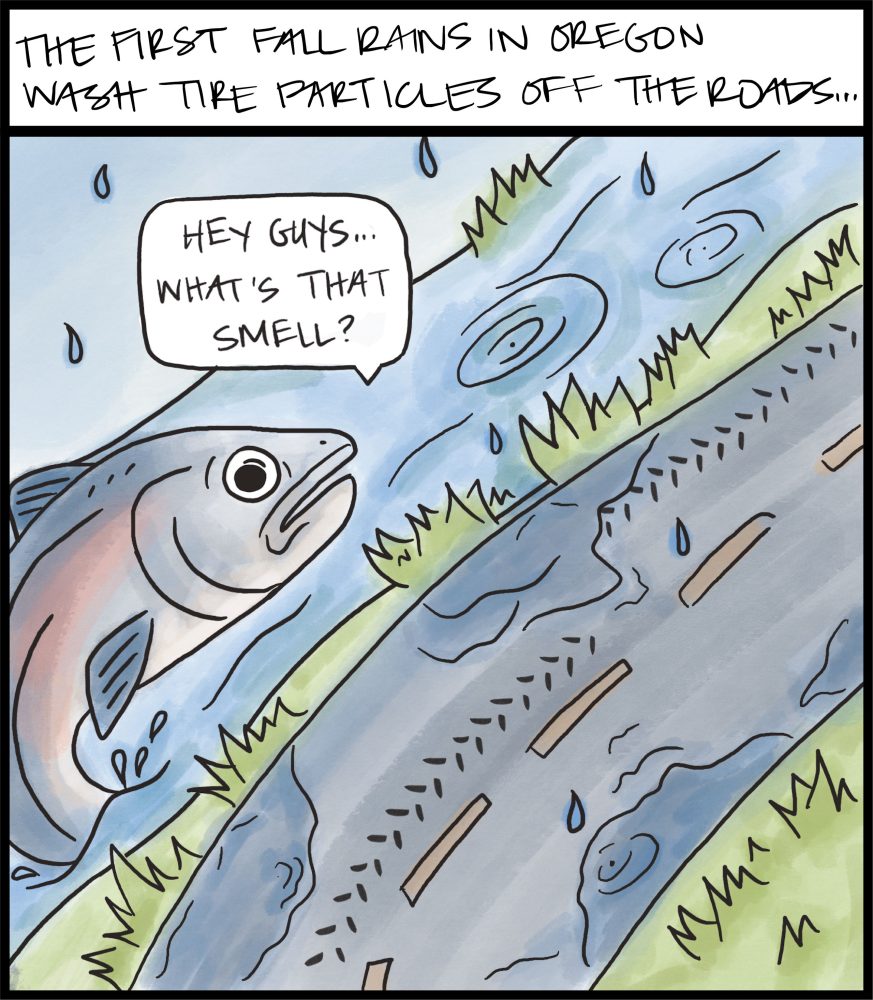
The compound is acutely toxic to salmon, which are crucially important as cultural and game species and as transporters of marine-derived nutrients to upstream ecosystems. The first fall rains wash runoff from the roads into the rivers, just in time for salmon to return from the Pacific Ocean to spawn in rivers in Oregon, Washington, and California.
But 6PPD-quinone may be only part of the problem, Oregon State University toxicologist Dr. Stacey Harper told science writers during the Council for the Advancement of Science Writing’s New Horizons in Science briefing at the ScienceWriters2026 conference in Corvallis, Oregon., on Sept. 26.
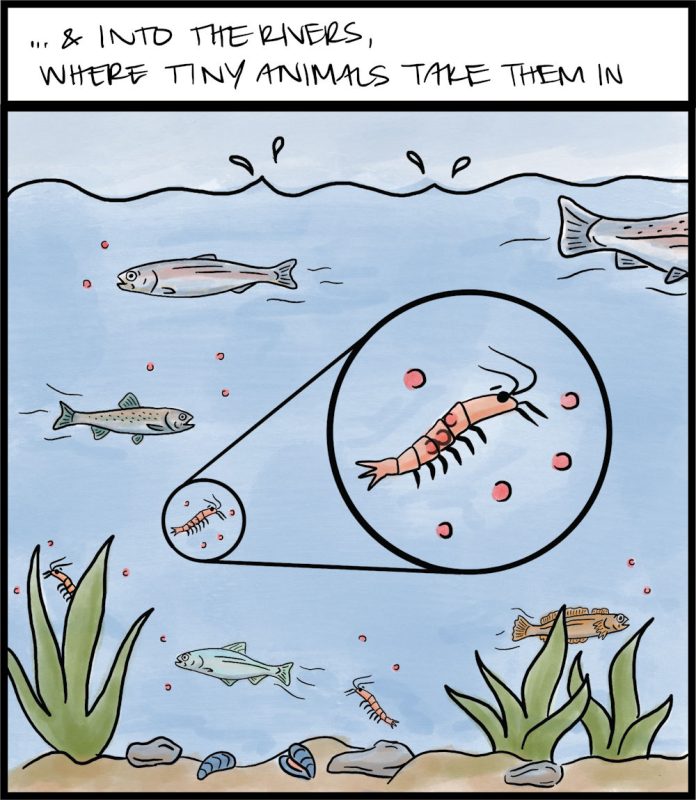
As tires wear down, they shed particles that break into pieces too small to see: nanoplastics that can slip into the tiniest animals at the base of the food web. Her lab’s research suggests these particles can stunt growth and alter behavior in fish and shrimp, with effects that could ripple through the ecosystems salmon depend on.
“The one plastic that we’ve been studying that has been the most toxic are tire particles,” said Harper.
Nanoplastics are particles smaller than one micron in diameter, invisible to the naked eye.
“Those nanoscale [plastics] are the ones that can get into the smallest of critters, which makes up the base of the food web,” Harper said. When a predator eats an animal that has consumed nanoplastics, those particles pass into the predator’s body.
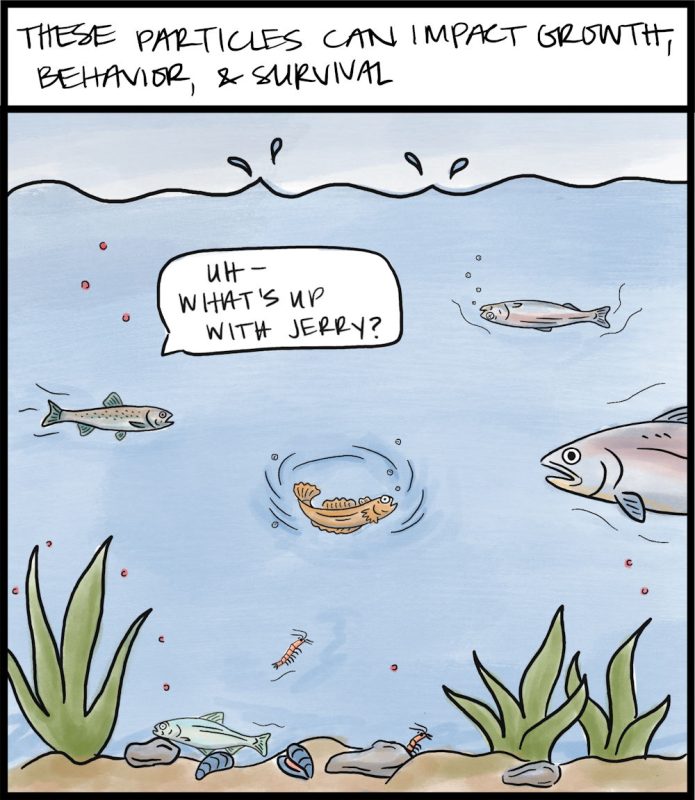
This is why plastic tire particles, not just the chemicals that leach from them, are concerning for local wildlife. Harper and her colleagues have found that these particles cause reproductive and developmental abnormalities in zebrafish embryos, a common lab model organism. In a study Harper conducted with Susanne Brander, an ecotoxicologist at Oregon State University, tire particles altered swimming behavior and stunted growth in both small estuarine fish and mysid shrimp. These might sound like small changes, but they can determine whether a young animal survives long enough to reproduce.
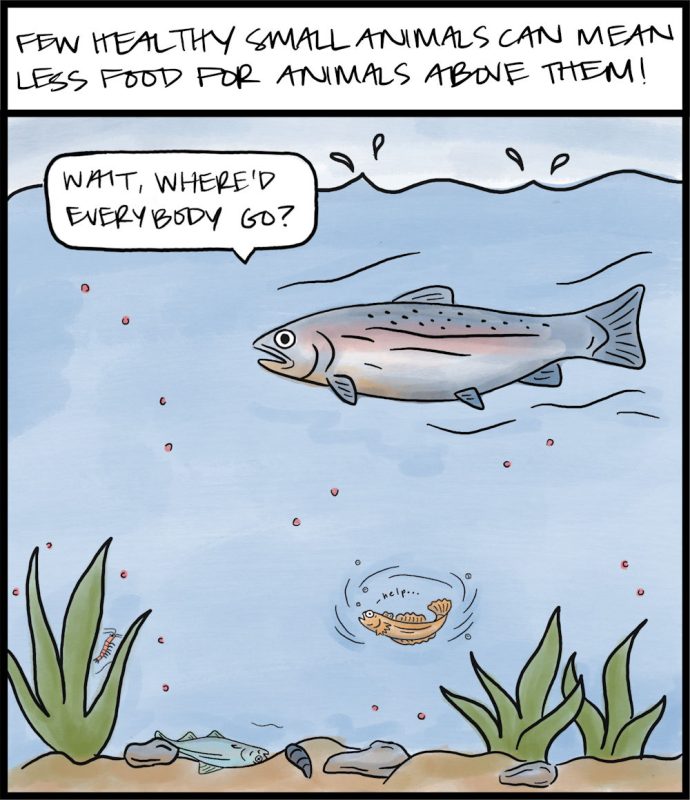
Small animals like mysid shrimp are food for larger fish, birds, and whales, and the effects on their populations can ripple up the food web. Harper noted that gray whales off the Oregon coast, which feed heavily on mysid shrimp, have been found with plastic in their poop.
Nanoplastics are a long game. They aren’t acutely toxic; a single exposure won’t kill an animal quickly. But small effects on growth and survival, repeated over years, can shrink some species’ populations relative to others, changing who lives in an ecosystem and who eats whom.
The problem is growing: Harper asserts that plastic production will quadruple in the next 30 years, a future she calls “the Plasticene” in which plastics will be found in nearly every environment. “All the way down to the Mariana Trench, all the way up to the top of the Swiss Alps, we’re finding microplastics,” said Harper.
Every fall, the first rains will wash road debris into rivers, and what they carry is getting smaller and harder to study. As Harper puts it: “As plastics break down, so does our understanding about them.”