A journalist who focuses on Indigenous knowledge — and solutions
Bull kelp, the focus of a restoration project in Northwest Washington that draws on Indigenous knowledge. (Photo by Bianca Santino.)
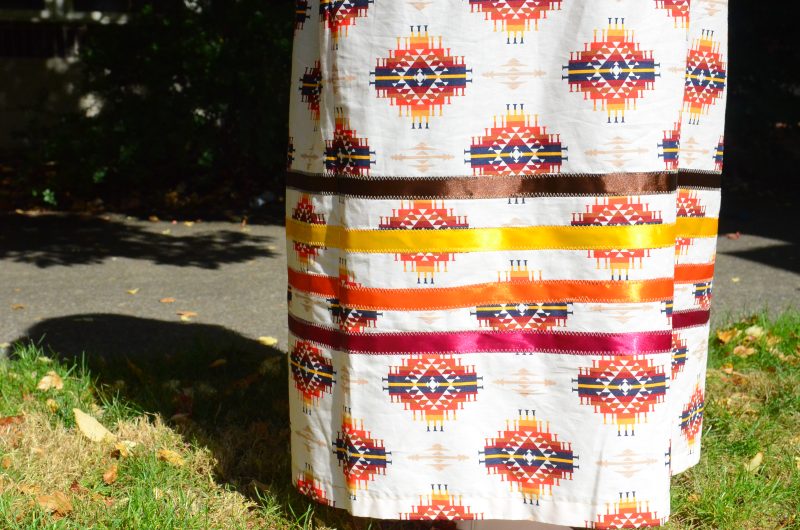
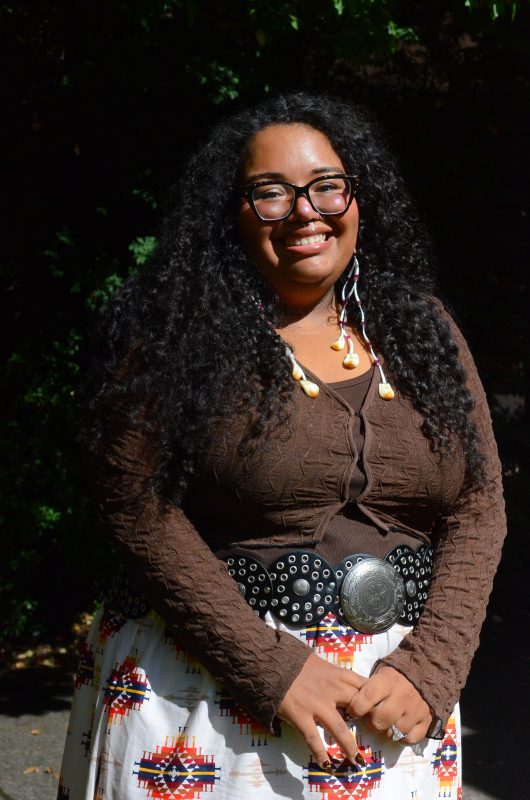
As Lyric Aquino walked up to the stage at Oregon State University Sept. 27, earrings crafted from elk teeth, dentalium, and crystals dangled from her ears. She wore white moccasins, a silver belt and a skirt adorned with earth-toned ribbons at the bottom.
“My grandma made this for me,” Aquino said, noting the skirt has pockets. “She was so excited and so proud to hear me speak — it’s like she’s here with me.”
Two years before, Aquino had attended a ScienceWriters conference with support from a travel fellowship. At this year’s conference in Corvallis, Ore., she was a speaker, sharing how her Indigenous perspective informs how she tells science stories. She is a citizen of Ohkay Owingeh Pueblo and also has Isleta Pueblo and Jicarilla Apache ancestry.
“This is a full-circle moment for me,” Aquino said. “Now, to be someone who’s speaking as an authoritative source on what I’m reporting on, seeing how I can support journalists — it’s honestly really magical.”
Aquino works as an Indigenous affairs reporter at Underscore Native News, where she covers Indigenous Traditional and Ecological Knowledge (ITEK).
“I am a science gal through and through,” Aquino said. “I love to bridge that with the intersectionality of my culture and indigeneity.”
ITEK centers Indigenous voices and oral traditions as a valid form of science that shouldn’t be overlooked in favor of Western scientific methods. It includes listening to tribal leaders, elders, and historians to guide environmental work.
“Anecdotal evidence is a major key in Indigenous sciences and has been a practice that’s been upheld for tens of thousands of years,” Aquino said. She added that science is an integral part of Iindigenous communities and their cultures.
“It’s often tied to livelihoods. It’s tied to the way people eat, the way they gather, the way that their home structures are built,” Aquino said. “It’s a part of their everyday lives in a way that Western science really isn’t.”
A recent piece she reported for Underscore Native News focused on the Samish Indian Nation’s traditional homelands, an island off the coast of Northwest Washington. There, the Puget Sound Restoration Fund replanted bull kelp, a type of native seaweed that shelters marine life.
To map where to plant the kelp, scientists drew on the oral traditions of current elders, who had been fishing in the area for their entire lives.
“Because there were hot spots where it was quite popular for fishing, they saw activity of different animals, and knew where the kelp beds were,” Aquino explained.
In the less than a year since the project was completed, the kelp beds have grown significantly.
Aquino noted that the story was an example of the solutions journalism model, which uses four pillars to report on investigations: response, insight, evidence, and limitations.
The model allows reporters to explore scientific evidence “in a way that’s not greenwashing,” Aquino said. In addition, she said the model can help journalists discuss how Western science methods might not be the best solution to a problem.
In another story, Aquino reported on the Coquille Indian Tribe’s partnership with the Oregon Department of Fish and Wildlife to revitalize the Chinook salmon population. In the Coquille River, Chinook numbers were falling to near-extinction levels. Before tribal fishing officers were listened to, efforts to bring back the salmon were unsuccessful.
After becoming co-managers of the land, the Coquille were successful in revitalizing the population, redesigning salmon traps and implementing traditional fishing methods that dramatically increased the number of Chinook collected for the river’s salmon hatchery.
“This story showed that their traditional collective knowledge works,” Aquino said.
However, she warned against the fetishization of Indigenous ways of knowing and traditional ecological methods, or the victimization of tribes.
“Colonization is ongoing,” she said. “You have to build relationships and don’t parachute in to do these stories.”
When connections are made, and communities feel heard, the impact can be felt in Indian Country. “It’s a learning curve,” Aquino said. She added she’s still an active learner, too.