Is un-hackable, verifiable voting possible?
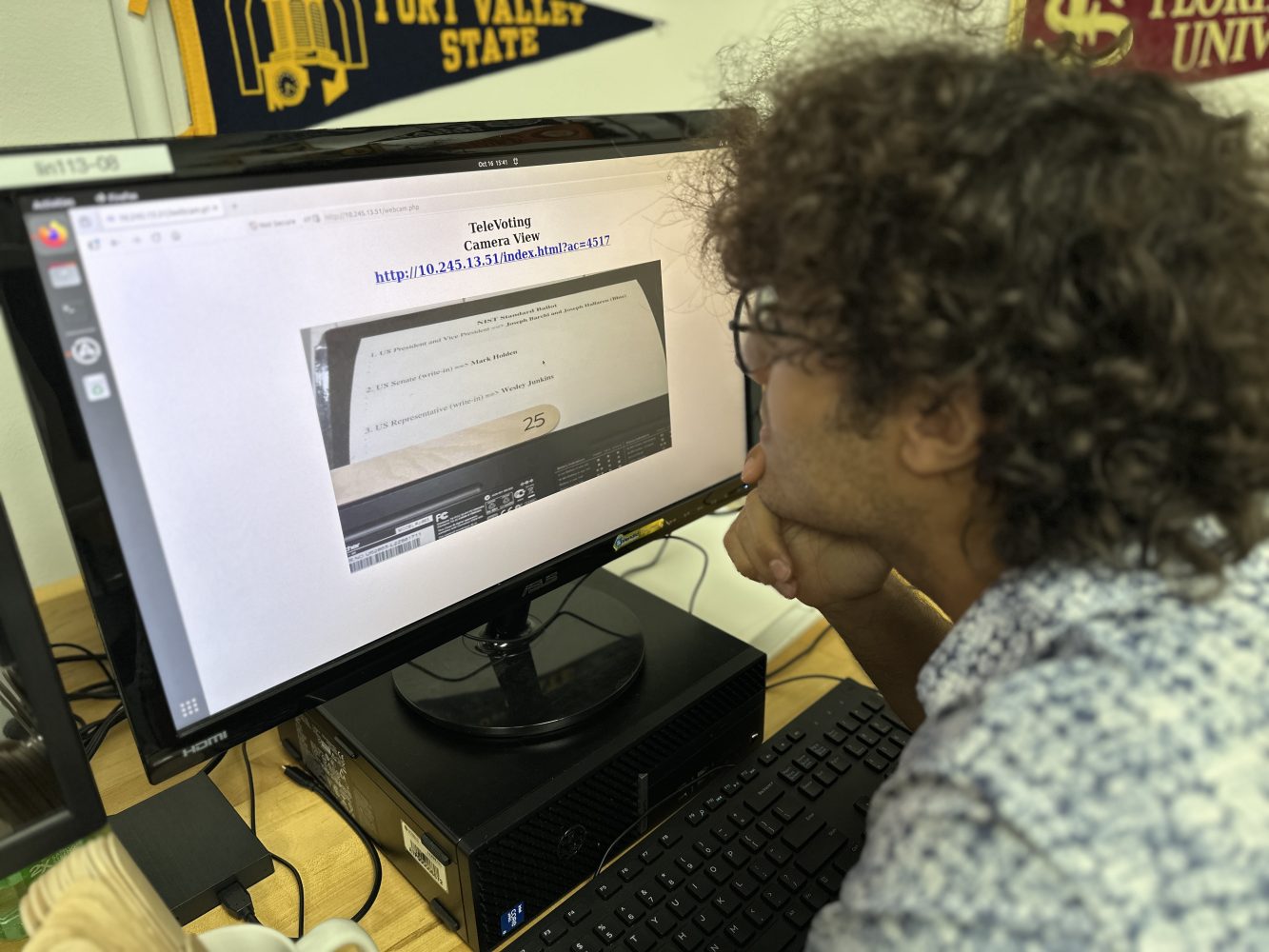
A volunteer from the Computing for Social Good Lab tests the televoting system. (Photo by Juan Gilbert)
What if there was a tamper-proof, reliable, and accessible voting system available to all U.S. citizens?
Juan Gilbert, a computer science professor at the University of Florida (UF), is on a mission to implement such a system. With his team, Gilbert spent the last 23 years developing a transparent voting machine, open-source voting software, and a remote system for absentee voters.
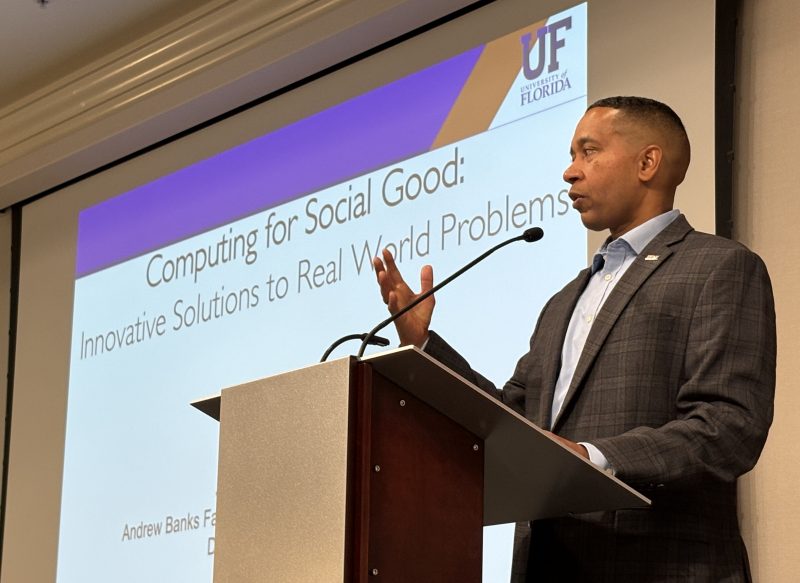
“We created Prime III, which is the first universally designed voting system in this country. Meaning, at that time, if you can’t see, if you can’t hear, if you don’t have arms, you could vote on the same technology with anyone else,” Gilbert said as he delivered the 14th Patrusky Lecture at the ScienceWriters2026 conference at Oregon State University in Corvallis, Ore., Sept. 26.
The lecture, which provided examples of how computational technologies can be deployed for social good, was part of the Council for the Advancement of Science Writing’s New Horizons in Science briefings.
In July, President Trump cited security vulnerabilities in voting machines and ballot counting systems as a national concern, while according to a Pew Research Center survey, only 55% of Americans are confident that the 2026 midterm elections will be conducted fairly and accurately.
In Gilbert’s view, the future of reliable in-person voting could look like this: Voters select candidates using open-source, accessible offline software displayed on a transparent OLED touchscreen, where each pixel emits its own light without a backlight.
After the printer behind the transparent screen marks a paper ballot, voters can continue using the software, Prime III, to immediately verify their votes by tapping the part of the screen that intersects with the page. If the ballot is printed incorrectly, they can notify an election official at the polling location, who would “spoil” the ballot so that it won’t be counted.

Today, most voters use one of three voting methods: marking a paper ballot, which is then scanned for vote tabulation; a direct-recording electronic system (DRE), where votes are recorded directly into a voting machine; or a ballot-marking device, which produces a ballot from the voter’s marks on an electronic display.
Ballot-marking devices are intended to help voters review the ballot before it is submitted and protect against mistakes and fraud. However, studies published in the IEEE Symposium on Security and Privacy and the Election Law Journal found that not enough ballot-marking device users actually verified their ballot.
“Once we saw the issue, we had to devise an approach to ensure voters verified their ballot,” Gilbert said. “This led to the idea of turning paper into a touchscreen, which led to the transparent voting machine.”
In 2007, the U.S. National Science Foundation granted $93,056 to fund the project, and in 2011, the U.S. Election Assistance Commission awarded $4.5 million. But a lack of industry partners has kept the technology from being deployed at the polls.
“I’m not a voting machine manufacturer. I’m not a vendor. What we’re doing is creating technologies, and we hope they would translate into the real world. So vendors need to adapt what we’re doing,” Gilbert said.
Until then, the project lives on at UF’s Computing for Social Good Lab, where Gilbert and his colleagues design technologies with people in mind. While development has slowed, they continue to provide demos of televoting, a remote voting system for absentee voters that utilizes a version of the Prime III software.

In this system, a voter can join a video call remotely, select their candidates, and verify each selection by viewing a live video feed of the printer. In order to prevent deepfakes and avoid artificial agents from impersonating voters, the primary poll worker regularly conducts a “liveness test” with numbered popsicle sticks, with partisan observers in the same room.
To prove whether his voting system is indeed tamper-proof, Gilbert invited others to test the transparent voting machine. At UF, he led a seven-day event called “Hack It If You Can” where three teams of undergraduate and graduate students were challenged to flip votes without anyone noticing.
Nobody succeeded.
The system is difficult to hack in part because it lacks network connections. The marked ballot is produced by a basic thermal printer, which uses heat instead of ink, and is not wi-fi or network capable. “Network connections require hardware. Simple: Don’t include that hardware,” Gilbert said.
Unfortunately, contract difficulties prevented Gilbert from entering his system in the voting-machine hacking competition at DEF CON, an annual cybersecurity conference. Despite the setback, Gilbert continues to look for industry partners interested in improving their voting systems.
“I’m kind of saddened by it because I thought if I built an unhackable voting machine, everybody would want that thing,” Gilbert said. “I’ll talk to anybody. [With] the stuff we’re doing in voting, it would take someone who really wants elections to work.”