Science students and travel fellows cover microplastics, AI, the “Big One,” ITEK and more at ScienceWriters2026
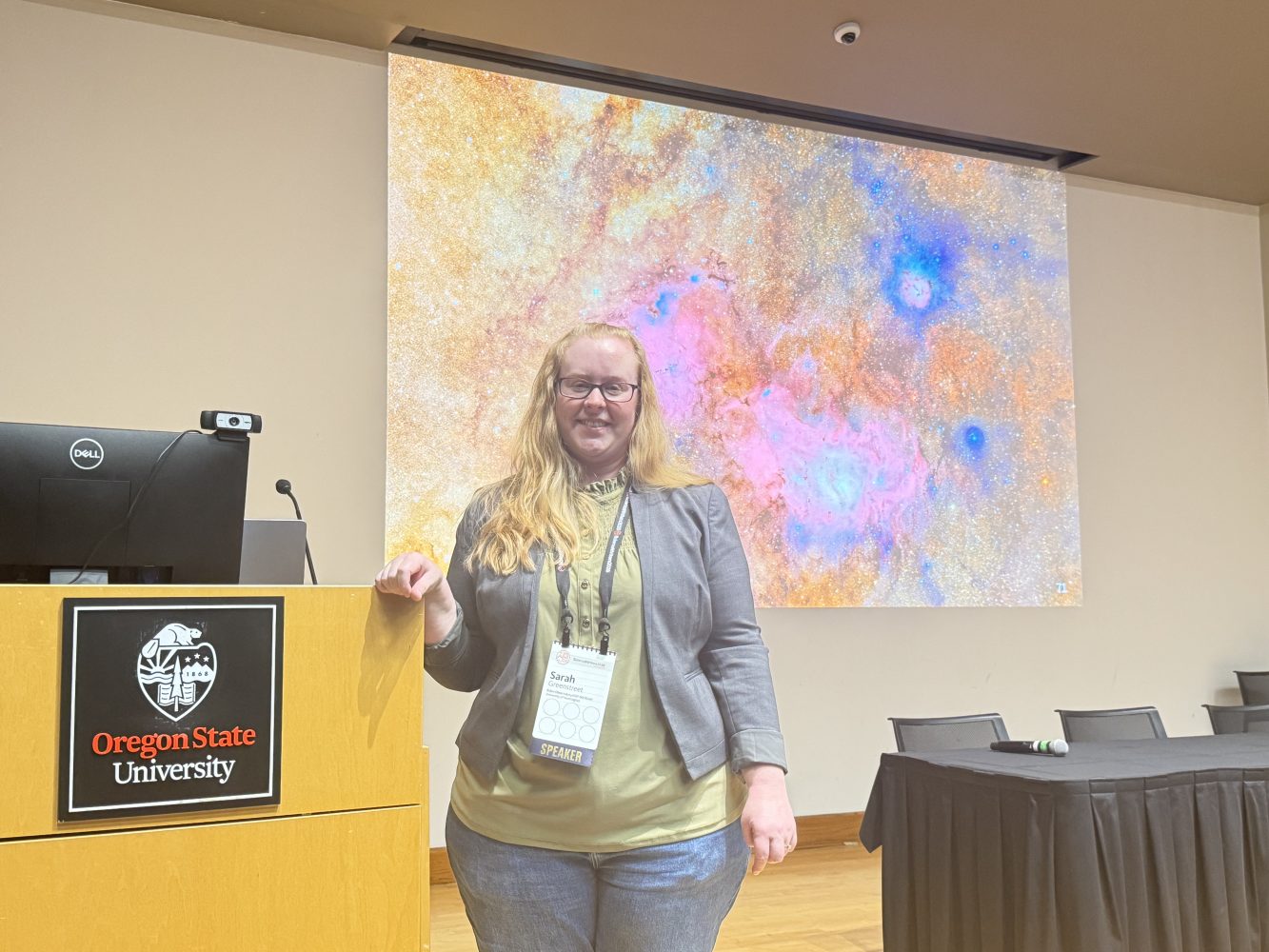
Sarah Greenstreet, an astronomer at NSF’s NOIRLab and the University of Washington, describes the Rubin Observatory during the New Horizons in Science briefing at the ScienceWriters2026 conference in Corvallis, Oregon. (Photo by Wardah Noor)
At ScienceWriters2026, 10 science graduate students and nine New Horizons travel fellows covered the 64th annual New Horizons in Science briefings and the 14th Patrusky Lecture. They filed stories on topics ranging from Pacific Northwest earthquake hazards, microplastics, AI, and “good fire” to Indigenous Traditional Ecological Knowledge, GLP-1 drugs, and the “Make America Healthy Again” movement as part of the 2026 New Horizons Newsroom.
The graduate students were participants in the annual ComSciCon-SciWri workshop, which provides early-career scientists an opportunity to take a hands-on approach to science journalism at North America’s largest annual convening of science journalists and writers.
Each student was paired with a professional mentor and assigned to cover a briefing alongside a New Horizons Fellow. This year’s mentors were Marla Broadfoot, Sanjana Curtis, Sarah DeWeerdt, Jeremy Faust, Natalie Jonas, Bing Lin, Rudy Molinek, Jackie Flynn Mogenson, Rodrigo Perez-Ortega, and Jill Sakai. Most of the mentors were past winners of the Eric and Wendy Schmidt Awards for Excellence in Science Communications, who participated in a side workshop at the conference supported by Schmidt Sciences.
After meeting a 48-hour deadline, each writer went through a rigorous editorial process designed to emulate the editing in a professional newsroom. Stories received at least two rounds of editing and fact-checking by CASW Senior Advisor Rosalind Reid, as well as CASW Executive Director Meaghan Parker and CASW Cybrarian Cindy MacDonald.
The 2026 ComSciCon workshop was supported by generous funding from the Burroughs Wellcome Fund and AAAS EurekAlert! The 2026 New Horizons Travel Fellowships were supported by Burroughs Wellcome and other sponsors and supporters of CASW.
Read their stories:
- GLP-1 drugs: Randy Seeley sets the TikTok record straight
- The race to understand earthquake hazards in the Pacific Northwest
- The other side of wildfire: ‘Good fire’ in the Pacific Northwest
- Indigenous people’s traditional ecological knowledge holds answers for Western scientists — if they listen
- It’s not you, it’s your set point: Societal considerations of GLP-1 drugs
- How journalists can help the public separate fact from fiction in the MAHA movement
- AI is moving faster than the rules meant to govern it, panelists say
- The government promoted a new treatment for autism based on scant evidence. Journalists should cover the fallout.
- Is un-hackable, verifiable voting possible?
- Rethinking land management with ‘good fire’
- MAHA in the media: Are science journalists meeting the challenge?
- The answer to our questions about AI might be to keep asking questions
- Rubin’s huge eye could help defend Earth, but satellites are getting in the way
- Will Oregon cities be prepared for the Big One?
- Tiny particles make big ripples
- The sky belongs to everyone now, thanks to the Vera C. Rubin Observatory
- A journalist who focuses on Indigenous knowledge — and solutions
- Q&A with Juan Gilbert: How artificial intelligence could be used for social good
- Microscopic plastics: A growing health concern for human health?